Why You Keep Hiding Your Handmade Work — And How to Finally Stop
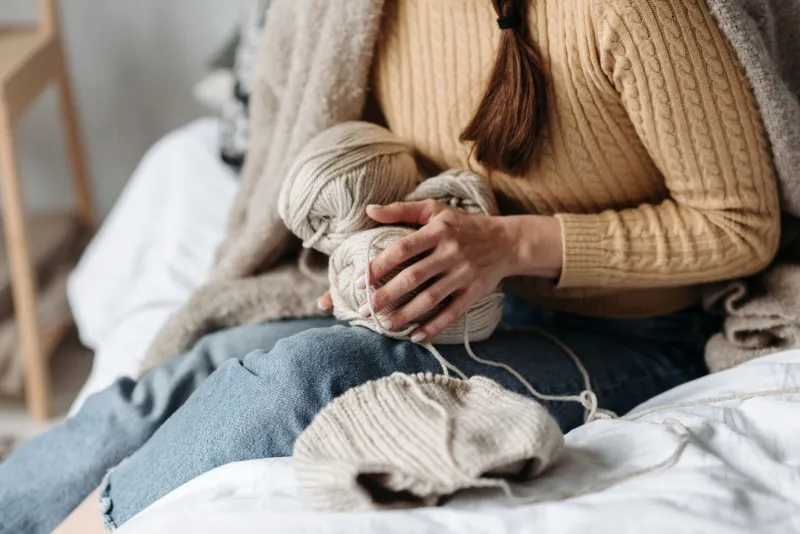
You finished the blanket. You wove in the ends, blocked it out, and honestly? It looks pretty great. Then someone asks if they can see it, and something weird happens. You shrug it off. Oh, it's nothing. It came out a little uneven. I'm still learning. The blanket gets folded up and tucked away, unseen.
Sound familiar? You're in good company. Across every corner of the maker world — knitters, crocheters, embroiderers, weavers — there's a quiet epidemic of talented people who genuinely don't believe their work is good enough to be seen, shared, or celebrated. Researchers and creative coaches have started calling this the craft confidence gap, and it's worth talking about, because it's costing makers a lot more than they realize.
What the Confidence Gap Actually Looks Like
It doesn't always show up dramatically. Sometimes it's the half-finished project you abandoned because a stitch looked "off." Sometimes it's the Etsy shop you've been meaning to open for two years but haven't because who would even buy this? Sometimes it's the gift you gave with a string of apologies attached — I know it's not perfect, it's a little lumpy, you don't have to use it.
All of these behaviors have something in common: they're rooted in the belief that handmade work has to meet some invisible standard before it's allowed to exist in the world. And that standard? It shifts constantly. It's never quite reachable. That's the trap.
Creative psychologists describe this as a form of perfectionism-driven avoidance — where the fear of being judged as "not good enough" feels more threatening than the disappointment of never finishing or sharing at all. In maker communities specifically, this gets tangled up with imposter syndrome: the persistent feeling that everyone else knows what they're doing and you're just pretending.
Why Makers Are Especially Vulnerable
Here's the thing about craft: it's visible in a way that a lot of other skills aren't. When you knit someone a sweater, they can hold it, wear it, examine it up close. Every tension inconsistency is right there. Compare that to, say, writing a report at work — no one's inspecting your paragraph spacing under a magnifying glass.
On top of that, social media has created a curated highlight reel of maker work that can feel genuinely intimidating. When your feed is full of flawless flat lays and perfectly color-matched yarn hauls, it's easy to forget that you're comparing your behind-the-scenes to someone else's carefully edited finished product.
And then there's the cultural message a lot of us absorbed growing up: that handmade is a lesser alternative to "real" (read: store-bought) goods. That framing is slowly shifting, but it left a mark. Many crafters internalized the idea that what they make is inherently second-rate — a nice gesture, maybe, but not something to take seriously.
The Reframe That Actually Works
Here's what experienced makers — the ones who've moved past the hiding stage — tend to say when asked how they got there: they stopped chasing perfect and started chasing present.
That sounds a little abstract, so let's break it down. Imperfection in handmade work isn't a flaw to apologize for. It's literally what makes it handmade. The slight variation in tension, the place where you switched yarn mid-skein, the tiny wobble in an otherwise straight seam — these are the fingerprints of a real human being who sat down and made something with their hands. No machine produces that. No algorithm generates it. It's irreplaceable.
Artisans who sell their work successfully will often tell you that customers don't just tolerate these characteristics — they actively seek them out. People buying handmade goods want the evidence of a human touch. They're paying for the story behind the object, not just the object itself.
So when you call your work "imperfect," try replacing that word with authentic. Not as a feel-good trick, but as an accurate description of what handmade actually is.
Practical Moves to Start Closing the Gap
Finish the thing. One of the most powerful confidence-builders available to any maker is simply completing a project — even one you're not thrilled with. Finishing builds momentum. It proves to your brain that you can see something through, and that evidence stacks up over time.
Share before you're ready. This one stings a little, but it works. Posting a work-in-progress, showing a finished piece to a friend, or bringing your knitting to a local stitch-and-chat group before you feel "good enough" interrupts the cycle of waiting for a confidence that only comes from doing. The feedback is almost always warmer than you expect.
Separate the work from your worth. Your crochet tension is not a reflection of your value as a person. This sounds obvious, but a lot of makers have unconsciously linked the two. A dropped stitch is a dropped stitch — it's fixable, or it's not, and either way it says nothing about whether you deserve to make things.
Find your people. Online craft communities — particularly the ones centered on specific crafts or yarn types — tend to be remarkably encouraging spaces. Connecting with other makers who share their process openly (including the mistakes) normalizes the learning curve in a way that's hard to replicate solo.
Look back, not just forward. Keep a photo log of your projects over time. Makers who do this are often genuinely shocked by how much their skills have developed. Progress is real, but it's easy to miss when you're always focused on the gap between where you are and where you think you should be.
The Permission You've Been Waiting For
Here's the honest truth: nobody is going to hand you a certificate that says your work is finally good enough to share. That moment doesn't come from outside. It comes from deciding — sometimes repeatedly, sometimes daily — that what you made matters because you made it.
The crafters who show up, share their work, and build something meaningful out of their making aren't the ones who figured out how to be perfect. They're the ones who decided that imperfect and present was better than polished and invisible.
Your blanket deserves to be seen. So do you.