Put It on Display: Why Showing Off Your Handmade Work Is the Best Thing You Can Do for Your Craft Life
There's a basket in a lot of crafters' homes — maybe a closet shelf, maybe a spare bedroom corner — where finished projects go to disappear. A chunky knit throw that came out a little uneven. A crocheted wall hanging that felt exciting to make but somehow never made it onto a nail. A set of dishcloths you gifted yourself but never actually pulled out of the drawer.
Sound familiar? You're not alone. A surprising number of people who make things by hand are also really good at hiding what they've made. And while there are a lot of reasons for that (perfectionism, imposter syndrome, the general fear that someone will notice the tension is off on row twelve), there's a real cost to keeping your work tucked away.
Because here's the thing: displaying your finished projects isn't just an aesthetic choice. It's actually one of the most powerful things you can do for your creative momentum.
Your Brain Keeps Score — Whether You Know It or Not
When you finish a project and immediately move on without acknowledging it, you miss a step that matters more than you might think. Psychologists who study motivation talk a lot about something called "evidence of progress" — the idea that visible proof of what you've accomplished acts as fuel for future effort.
In other words, your brain needs to see what you've done in order to believe you're capable of doing more.
When a finished hat sits in a bin, your subconscious doesn't get to count it. But when it's hanging on a hook by your front door? Every single time you walk past it, something small but real happens: you get a quiet reminder that you made that. You figured it out. You finished.
Over time, those small reminders stack up into something that looks a lot like confidence.
The Perfectionism Trap (And How a Shelf Gets You Out of It)
Perfectionism is maybe the most common reason crafters keep their work hidden. If it's not quite right, it doesn't feel worthy of display. But that logic creates a loop that's almost impossible to escape — because if nothing you make ever gets celebrated, nothing ever feels good enough to celebrate.
Displaying imperfect work is actually a practice in itself. When you put that slightly-off tension scarf on a chair and let it live there, you're training yourself to see the whole thing — the effort, the learning, the hours — instead of just the flaw on row eight.
A lot of crafters who make the shift from hiding their work to showing it describe the same experience: once something is out in the world, in their actual living space, they stop seeing the mistakes as the main event. The piece becomes just... a piece. Something they made. And that reframe is genuinely freeing.
Practical Ways to Display Different Project Types
Not every project wants to live the same way. Here's how to think about styling different kinds of handmade work around your home.
Blankets and Throws
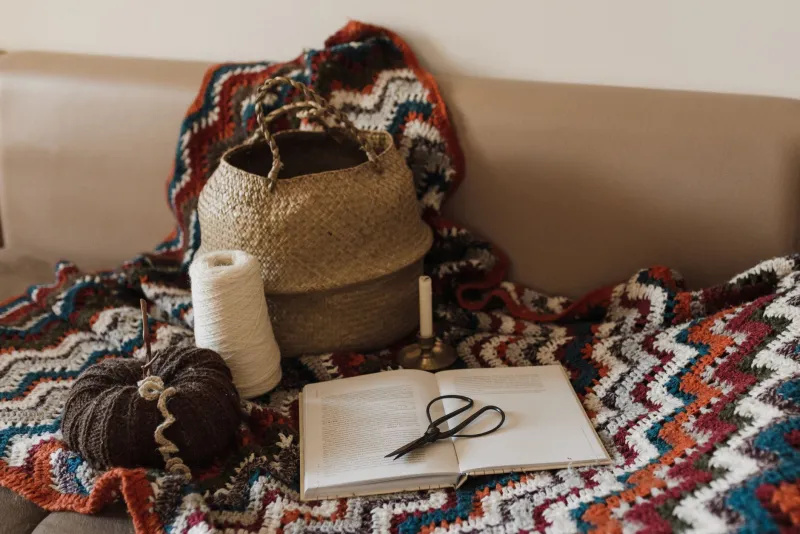
These are the easiest wins. Drape a finished blanket over the arm of your couch, fold it over a ladder shelf, or hang it from a decorative quilt rack. A chunky knit throw casually tossed over a chair doesn't look like a craft project on display — it just looks like a cozy, well-styled room. Nobody has to know it took you three weeks and two restarts.
Hats, Scarves, and Wearables
A row of simple wall hooks near your entryway does double duty: it keeps seasonal accessories organized and turns them into a little gallery of what you've made. Rotate pieces in and out as the seasons change. It's functional, it's pretty, and every time a guest compliments your hat collection, you get to say you made those.
Smaller Items and Dishcloths
These often get buried in drawers, which is a shame because they're genuinely charming. Stack colorful dishcloths in a basket on the kitchen counter. Arrange a few small crocheted coasters as an actual table setting. Use a handmade mug rug under your coffee. The goal is to make your handmade things part of daily life, not special-occasion objects you're saving for some future moment that never quite arrives.
Wall Hangings and Fiber Art
If you've made anything specifically meant to hang — macramé, woven pieces, embroidered hoops — please, for the love of yarn, hang them. A blank wall above a bookshelf or beside a window is a perfect spot. Group a few smaller pieces together for a gallery-wall effect. These pieces were made to be seen, and seeing them every day will remind you that you're someone who makes art.
Create a Dedicated "Maker's Corner"
If you have a craft space — even a small one — consider giving it a visible "finished projects" display area. A short shelf above your work table, a corkboard with photos of completed pieces, or even just a hook where your latest finished item hangs before it gets gifted or put to use.
This creates a physical record of your output that you actually see while you're working. When a project gets hard or you're in that awkward middle stage where nothing looks right yet, glancing up at a shelf full of things you actually finished is a surprisingly effective motivator.
It says: you've done this before. You can do it again.
The Gift You Made Deserves a Photo, Too
A lot of handmade work leaves your hands before you get a chance to display it — gifts, donations, items sold. If that's you, start photographing your finished projects before they go. Print a few of your favorites and pin them somewhere in your craft space, or keep a dedicated album on your phone.
You don't need to post them anywhere. This isn't about social media. It's just about having a record for yourself — a growing visual library of things you made with your own hands. Flip through it when you're stuck or uninspired or convinced you've forgotten how to do this. You haven't.
Start With One Piece
You don't have to redecorate your whole house. You don't have to turn your living room into a fiber arts gallery. You just have to pick one finished project — one thing you made that's currently folded up somewhere out of sight — and find it a home where you'll actually see it.
Put it on the couch. Hang it on a hook. Set it on the table.
Then notice what happens over the next few weeks. Notice whether you sit down to craft a little more willingly. Notice whether starting a new project feels slightly less like a risk.
That's the craft shelf effect. And it's been waiting for you to try it.